ZAYAN
ZAYAN: Disentangled Contrastive Transformer for Tabular Remote Sensing Data is a self-supervised, feature-centric framework that moves contrastive learning from the sample level to the feature level. ZAYAN learns robust, disentangled, and redundancy-reduced feature representations without labels during pretraining, then uses a Transformer for downstream classification.
1 West Virginia University, USA · 2 Green University of Bangladesh · 3 Stamford University Bangladesh

International Conference on Pattern Recognition
ICPR 2026 · Lyon, France · Oral Presentation
 View RRPR badge results ↗
What is ZAYAN?
ZAYAN stands for Zero-Anchor dYnamic feAture eNcoding. It is designed for tabular remote sensing and environmental data where features may be heterogeneous, redundant, noisy, and labels may be scarce.
Representation learning does not require class labels during ZAYAN-CL pretraining.
ZAYAN contrasts augmented views of feature columns rather than using samples as the main learning unit.
A redundancy penalty encourages diverse, angularly separated, and less redundant feature embeddings.
From Instance-Level Contrast to Feature-Level Contrast
Conventional contrastive learning usually begins from a sample or image patch. ZAYAN instead treats each tabular feature column as a learning unit and builds positive pairs from two stochastic views of the same feature.
Conventional contrastive learning
The learning anchor is typically a sample or patch.
ZAYAN feature-level contrast
Same-feature views are positives; other features provide negatives.
ZAYAN Architecture
ZAYAN separates self-supervised feature representation learning from downstream supervised classification while preserving the geometry learned during pretraining.
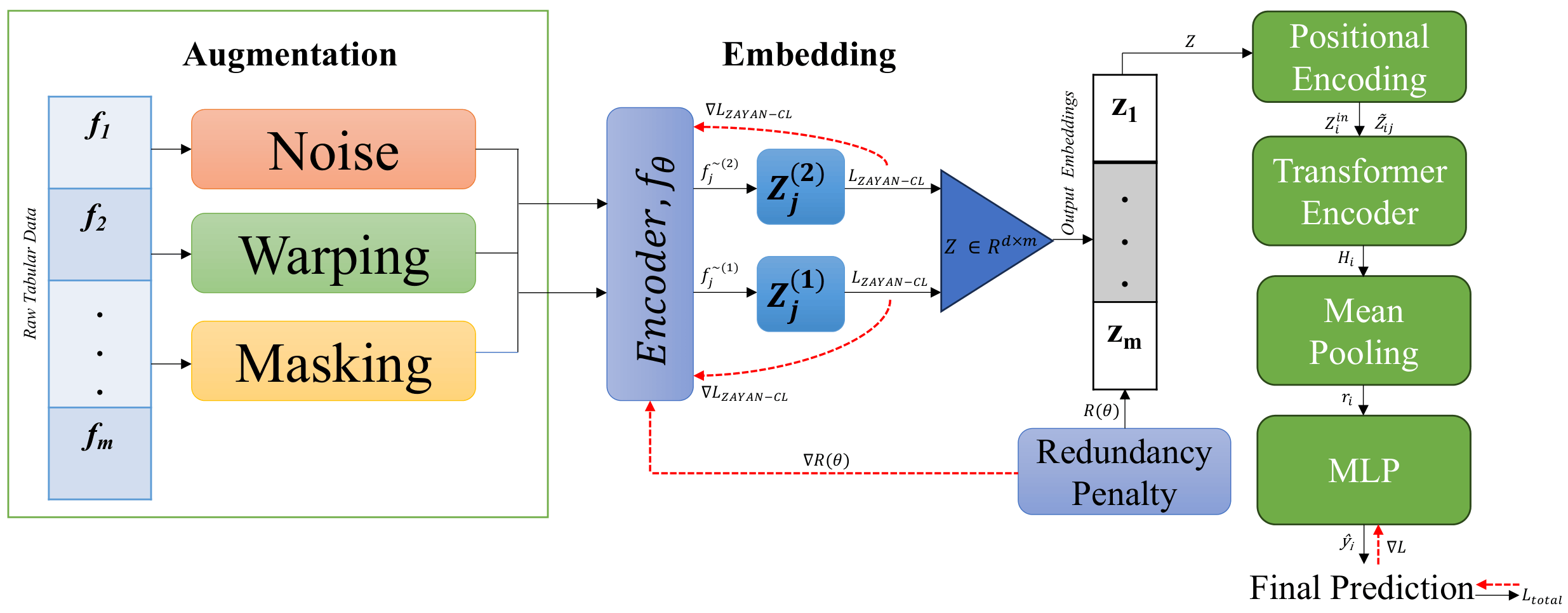
ZAYAN-CL: Zero-Anchor Feature-Level Pretraining
Training objective
For each feature \(f_j\), two augmented views are encoded as \(z_j^{(1)}\) and \(z_j^{(2)}\). The full ZAYAN-CL objective combines feature-level contrastive learning with redundancy reduction.
ZAYAN-T: Transformer for Downstream Classification
After ZAYAN-CL, the learned feature embeddings are treated as Transformer tokens. ZAYAN-aware positional encoding is added, the sequence is processed by a Transformer encoder, and the token outputs are mean-pooled before classification.
Experimental Setup
Benchmarks
675 samples · 147 features · 9 classes
4,839 samples · 5 features · binary
3,000-sample subset · 174 features · 7 classes
523 samples · 27 features · 4 classes
65,324 samples · 10 features · binary · synthetic balancing
5,631 images · ResNet features · PCA to 512-D · 4 classes
144,401 samples · 9 features · 5 classes · 50% injected noise
10,000 samples · 21 features · binary
Key Results Against Strong Tabular Baselines
ZAYAN obtains the best or tied-best mean accuracy across all eight benchmarks, ranking first on seven datasets and tying KNN on Crop Mapping. Its overall average rank is 1.06.
| Model | Urban | Wilt | Crop* | Forest | Tree+ | RSI# | Pluvial$ | Indian | Avg. Rank |
|---|---|---|---|---|---|---|---|---|---|
| TabR | 83.21±1.66 | 98.78±0.17 | 98.62±0.68 | 90.25±1.94 | 64.78±0.42 | 99.32±0.18 | 89.88±0.62 | 49.59±1.88 | 9.25 |
| TabM | 82.07±0.98 | 98.80±0.20 | 98.92±0.96 | 88.72±0.98 | 65.34±0.24 | 99.36±0.10 | 89.64±0.98 | 51.49±0.92 | 6.94 |
| TANDEM | 83.29±1.53 | 98.37±0.39 | 99.18±0.12 | 90.05±2.07 | 66.96±0.12 | 99.72±0.14 | 90.72±0.32 | 50.26±1.55 | 6.06 |
| TabICL | 83.30±0.98 | 98.76±0.17 | 99.46±0.10 | 90.05±2.35 | 66.98±0.20 | 99.74±0.16 | 90.75±0.74 | 51.27±0.66 | 3.38 |
| ZAYAN | 84.80±7.10 | 99.69±0.40 | 99.66±0.34 | 97.21±0.45 | 67.00±0.12 | 99.77±0.15 | 93.61±0.47 | 51.55±0.43 | 1.06 |
* Crop: 3,000-sample subset. + Tree: synthetic balancing. # RSI: ResNet features reduced to 512-D by PCA. $ Pluvial: 50% noise added to training data.
Ablation: What Makes ZAYAN Work?
Component and hyperparameter ablations on Urban Land Cover show that the full model benefits from contrastive learning, redundancy reduction, the preservation objective, and moderate stochastic augmentations.
84.80±7.10%
5-fold CV accuracy.
78.45±0.72%
Clear drop when \(\lambda=0\).
75.98±0.88%
MSE-only representation learning is weaker.
Robustness, Calibration, OOD & Deployment Diagnostics
Accuracy remains relatively stable under moderate feature shuffling and degrades more strongly under feature dropping.
Higher confidence thresholds improve accuracy on retained predictions while reducing coverage.
The study includes reliability, predictive confidence, entropy, synthetic OOD, and local sensitivity diagnostics.
ICPR 2026 RRPR Badge
Open RRPR Results ↗
ZAYAN is associated with an ICPR 2026 RRPR badge. The badge image is linked directly to the official ICPR 2026 RRPR results page so visitors can verify the recognition from the source.
Official RRPR ResultsICPR 2026 Oral Presentation
ZAYAN is presented as an oral paper at ICPR 2026. Use the official session page below for the conference schedule and session details.
Code, Paper & Resources
Install from PyPI
Takeaway
ZAYAN shows that feature-level self-supervision can be a strong recipe for tabular sensing data. ZAYAN-CL learns zero-anchor, redundancy-reduced feature embeddings without labels, while ZAYAN-T performs task-aware Transformer classification while preserving the learned structure.
Contrast is defined over tabular features and their augmented views.
Best or tied-best mean accuracy across all eight evaluated benchmarks.
Evaluation includes robustness, calibration, OOD behavior, and deployment-style diagnostics.
Acknowledgements
This work was supported in part by the International Association for Pattern Recognition (IAPR) through ICPR 2026 registration support. The authors would like to thank Dr. Md Mahedi Hasan for his kindness in presenting our work as a proxy presenter.
Citation
If you use ZAYAN in your work, please cite the ICPR 2026 paper.